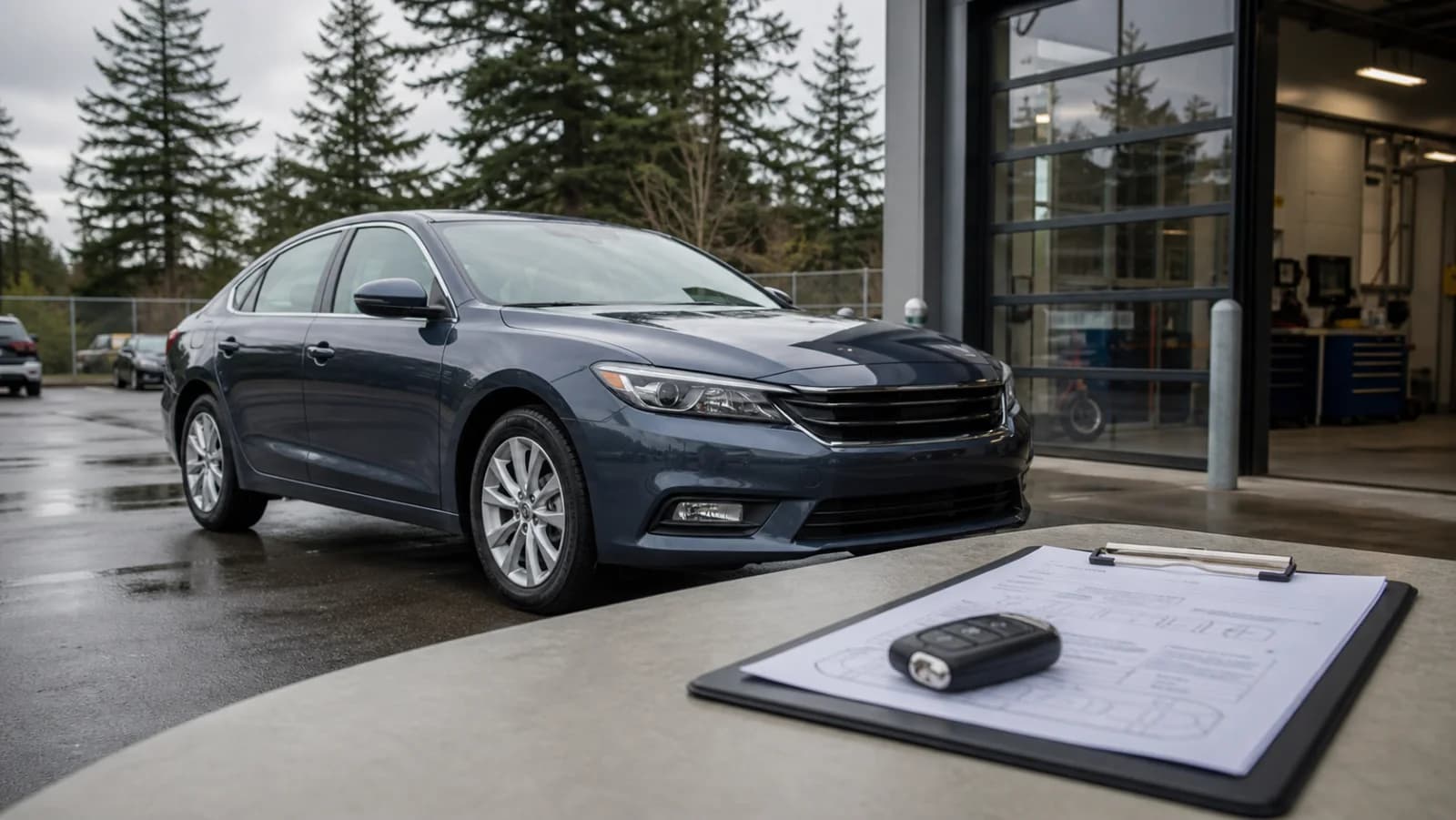
You leased a car. Someone else hit it. The body shop did good work, the dents are gone, and the vehicle drives like new. But a reported collision may now follow the vehicle into future valuations. The car may be worth less than it was the morning before the crash, even if the repair work looks excellent.
That lost value has a name: diminished value.
Oregon law provides a strong foundation for diminished-value claims. But when the damaged vehicle is leased, the analysis becomes more technical because the person driving the vehicle is not usually the person who owns the asset. This article explains how Oregon law treats diminished value, where the leased-vehicle complication comes from, and what a leaseholder and their attorney should do about it.
The core problem: you drive it, but someone else owns it
A lease splits the interests in the vehicle. The lessor, often a captive finance company such as Toyota Financial Services, Ford Credit, Honda Financial Services, or a similar financing entity, holds legal title. The lessee holds the right to possess and use the vehicle, along with contractual duties to maintain it, repair damage, comply with insurance requirements, and return it in the condition required by the lease.
Diminished value is usually framed as a loss to the owner's asset. But the person who may feel that loss economically is often the lessee, through repair obligations, turn-in charges, lease-end condition disputes, or buyout economics. That mismatch between title ownership and economic exposure is the source of most disputes involving diminished value on leased vehicles.
What diminished value means
Diminished value is the difference between what a vehicle was worth immediately before a collision and what it is worth after it has been fully and properly repaired.
The concept exists because many buyers will pay less for a vehicle with a documented accident history than for an otherwise identical vehicle with a clean history. That can be true even when the repair work was performed competently.
Practitioners generally divide diminished value into three categories:
- Inherent diminished value. The residual loss in value that remains because the vehicle was involved in a collision, assuming the repair was properly performed. This is the most common category asserted in modern auto claims.
- Repair-related diminished value. Additional loss caused by substandard repair, such as poor paint match, incomplete structural work, improper calibration, nonconforming parts, or repairs that do not meet manufacturer or lease standards.
- Immediate diminished value. The difference between the vehicle's preloss value and its value immediately after the collision, before repairs are made. This is usually more useful as an accounting concept than as the final measure of a repaired-vehicle claim.
Most practical diminished-value disputes involve inherent diminished value, repair-related diminished value, or both.
Oregon's diminished-value law
Oregon is a favorable jurisdiction for diminished-value arguments, but the cases are often described too loosely online. The important Oregon authorities should be read carefully.
The general measure of damages for injured personal property
Oregon's ordinary rule for damage to personal property is that damages are measured by the difference between the property's value immediately before and immediately after the injury. That rule appears in early Oregon authority, including Hansen v. Oregon-Washington R. & N. Co., 97 Or 190, 188 P 963 (1920), and later cases applying the same before-and-after framework.
One case frequently cited by appraisal services is Mock v. Terry, 251 Or 511, 446 P2d 514 (1968). Mock is useful, but it should not be oversold. It was not a modern accident-history stigma case. It involved valuation of a camper dealer's damaged inventory and addressed retail versus wholesale valuation issues. Its value for diminished-value claims is doctrinal: it confirms the before-and-after measure of damages for injured personal property.
That framework is also consistent with Restatement (Second) of Torts § 928, which allows recovery for harm to a chattel based on the difference in value before and after the harm, or, at the owner's election in an appropriate case, the reasonable cost of repair plus any remaining diminution in value after repair.
The early Oregon insurance cases
Oregon's foundational diminished-value decisions arose under first-party automobile insurance policies.
In Rossier v. Union Automobile Ins. Co., 134 Or 211, 291 P 498 (1930), the Oregon Supreme Court addressed the proper measure of recovery under an automobile collision policy. The court recognized that the appropriate measure of loss was not necessarily limited to repair cost if repair or replacement did not restore the vehicle's preloss value.
A caution for researchers: many websites misidentify the defendant in Rossier. The correct defendant was Union Automobile Insurance Company. The correct Pacific Reporter citation is 291 P 498, not 297 P 498.
In Dunmire Motor Co. v. Oregon Mutual Fire Ins. Co., 166 Or 690, 114 P2d 1005 (1941), the Oregon Supreme Court again addressed diminished value under policy language limiting liability to the cost to "repair or replace" the automobile or its parts with others "of like kind and quality." The court held that repair cost did not necessarily cap the insured's recovery where repair did not accomplish full restoration.
The modern first-party case: Gonzales
The controlling modern Oregon first-party case is Gonzales v. Farmers Ins. Co. of Oregon, 345 Or 382, 196 P3d 1 (2008), affirming 210 Or App 54, 150 P3d 20 (2006).
Gonzales should be read carefully. It was an insurance-policy interpretation case. It did not announce a universal tort rule for every diminished-value dispute.
Farmers paid to repair Jose Gonzales's pickup but refused to pay for the remaining loss in value. Farmers argued that its obligation to "repair" required only restoration of function and appearance. The Oregon Supreme Court disagreed. Under the policy language before the court, "repair" required restoration of the vehicle to its preloss physical condition. If the insurer did not or could not restore the vehicle to that condition, the insurer had to compensate the insured for the remaining diminished value.
There are two important limits to the holding.
First, the court emphasized the policy language before it. Gonzales was not a free-standing statute or tort rule.
Second, the court did not decide whether a first-party insurer must pay a claim based solely on accident-history stigma where the vehicle has been fully restored physically. The plaintiff in Gonzales alleged that the vehicle had not been restored to preloss condition. The Supreme Court expressly avoided deciding a pure stigma-only claim.
The court also noted that insurers may write policies defining "repair" to exclude diminished value. That matters. After Gonzales, many Oregon auto policies contain language limiting or excluding first-party diminished-value coverage. Whether your own collision policy covers diminished value depends on the specific policy language.
First-party and third-party claims are different
This distinction drives much of the analysis.
A third-party claim is a tort claim against the at-fault driver. In practice, it is usually presented to and adjusted by that driver's liability insurer. The legal claim is against the negligent driver, not against the insurer directly. Diminished value fits naturally within Oregon's before-and-after measure of property damage.
A first-party claim is a contract claim against your own insurer under your own policy. Under Gonzales, first-party diminished-value coverage depends on the policy language. If the policy promises repair and does not exclude diminished value, there may be coverage when repair does not restore the vehicle to its preloss condition. If the policy expressly excludes diminished value or limits repair obligations differently, the claim may be barred or narrowed.
In uninsured or hit-and-run situations, do not assume a property-damage route exists. Oregon requires uninsured motorist bodily-injury coverage, but uninsured motorist property-damage coverage is optional. Whether property damage, diminished value, or hit-and-run damage is covered depends on the policy.
The lease wrinkle: who can claim the loss?
Here is where leased vehicles diverge from owned vehicles.
Oregon appellate courts have not squarely decided whether a lessee, as opposed to the titled lessor, may recover inherent diminished value on a leased vehicle. The Oregon diminished-value cases involved vehicle owners or insureds claiming under their own policies. They did not resolve the leased-vehicle real-party-in-interest problem.
That means the analysis is governed by general principles: the measure of damages for injury to personal property, ORCP 26 A, the lease contract, any assignment or ratification, and the parties' respective economic interests in the vehicle.
Anyone who says Oregon diminished-value caselaw cleanly answers the lessee-standing question is overstating the law.
That does not mean the loss disappears. It means the claim must be presented carefully.
Practical paths for leased-vehicle diminished value
In practice, a leased-vehicle diminished-value issue usually resolves through one of three channels.
1. The third-party tort claim
The at-fault driver damaged the vehicle. The property-damage claim, including diminished value, is typically presented to the at-fault driver's liability insurer.
The complication is the real-party-in-interest issue. Because the lessor holds legal title, the liability carrier may argue that the lessee cannot recover for loss of market value to an asset the lessee does not own. ORCP 26 A generally requires an action to be prosecuted in the name of the real party in interest.
The lessee's counterarguments depend on the facts and the lease language. They may include:
- The lessee has a contractual duty to repair and maintain the vehicle.
- The lessee may be exposed to lease-end charges if the vehicle is returned with accident-related damage, nonconforming repairs, or diminished value reflected in the lease's return-condition process.
- The lessee may have a direct economic loss if the lessee intends to purchase the vehicle at the lease-end residual price.
- The lessor may assign, ratify, or join the claim.
The cleanest solution is usually a written assignment of the diminished-value claim from the lessor to the lessee. Some lessors will cooperate. Some will not. Another option is lessor participation, joinder, or ratification.
ORCP 26 A also contains a cure mechanism. An action should not be dismissed on real-party-in-interest grounds until a reasonable time has been allowed for ratification, joinder, or substitution of the real party in interest. That rule is not a substitute for good claim setup. It is a safety valve, not a litigation strategy. The better practice is to identify the lessor's position before suit.
2. The end-of-lease turn-in problem
This is the exposure that makes diminished value matter to a leaseholder even if they will never sell the vehicle.
Depending on the lease language, the lessor may assess charges at turn-in for unrepaired damage, substandard repair, excess wear, failure to satisfy return-condition requirements, or other accident-related condition issues. Some disputes arise because a vehicle was repaired, but not repaired to the standard required by the lease.
That is not always the same thing as a pure inherent diminished-value claim. A turn-in charge may be based on repair quality, missing documentation, nonconforming parts, remaining damage, frame or structural issues, or a lease-specific condition standard.
Two protective steps matter.
First, notify the lessor of the accident and repair in writing when it happens, not for the first time at turn-in.
Second, if the lessor states that the accident, repair history, or repair quality will result in a charge, get that position in writing. A written lease-end charge, preliminary inspection report, or lessor statement helps connect the lessee's economic loss to the collision.
3. The buyout scenario
If the lessee intends to exercise the lease purchase option, the economic injury becomes more concrete.
The residual value is typically set in the lease. If the vehicle has accident-related diminished value, the lessee may be paying a pre-set residual price for an impaired asset. Once the lessee buys the vehicle, the resale loss belongs directly to the lessee-owner.
That does not eliminate the need to address the lessor's interest before the buyout. But it often makes the lessee's economic stake easier to explain.
Repairs, parts, and GAP coverage
Several practical points come up repeatedly.
Repair to lease-compliant standards
Before repairs begin, review the lease's repair requirements. Many leases require repairs to be performed properly, with parts and workmanship that satisfy manufacturer or lease standards.
Ask for OEM or manufacturer-approved parts when appropriate. Get the parts specification in writing before the repair. Keep the estimate, supplement records, final invoice, photographs, calibration records, alignment records, and all communications with the shop and insurer.
Poor repairs can create a second problem: repair-related diminished value or lease-end condition charges on top of the inherent diminished value caused by the crash itself.
GAP coverage is not diminished value
GAP coverage addresses a different problem. It may apply when a leased or financed vehicle is totaled and the insurance payout is less than the remaining lease payoff or loan balance.
GAP coverage does not compensate for diminished value on a repairable vehicle. Clients often conflate the two, but they are separate concepts.
Practical checklist for Oregon leaseholders
- Confirm liability. Diminished value against a third party requires proof that someone else was legally responsible for the collision.
- Read the lease. Focus on insurance, repair, maintenance, wear-and-tear, excess-damage, and lease-end return provisions.
- Notify the lessor in writing. Do this promptly after the accident and again after repairs are completed.
- Repair the vehicle properly. Use a reputable shop and insist on lease-compliant, manufacturer-appropriate repairs.
- Keep the documentation. Save photos, estimates, supplements, invoices, parts records, calibration records, and all insurer and lessor communications.
- Use a qualified Oregon vehicle appraiser. For a paid opinion on vehicle value, confirm that the appraiser holds any Oregon vehicle appraiser certificate required under ORS 819.480 and ORS 819.482, unless an exception applies.
- Ask the lessor about assignment or ratification. If the lessor owns the market-value claim, the lessee should try to obtain a written assignment, ratification, or other written authorization.
- Document the lessee's economic loss. If the lessor will assess a charge, request that in writing. If the lessee intends to buy the vehicle, preserve the lease purchase-option documents.
- Make a written demand. Present the claim to the at-fault driver and the liability insurer with the appraisal, repair records, lease documents, and any lessor assignment or charge documentation.
Notes for Oregon attorneys
Real party in interest is the live issue
The defense issue in leased-vehicle diminished-value claims is usually not whether diminished value exists. It is who owns the claim.
Resolve the ORCP 26 A issue early. Secure an assignment from the lessor when possible. If assignment is not available, consider ratification, joinder, substitution, or direct lessor participation. Do not let the ownership posture become the carrier's cleanest trial defense.
Be careful with terminology. This is often called a "standing" problem in claims correspondence, but in litigation it may be more precisely framed as a real-party-in-interest problem under ORCP 26 A.
Limitations periods and claim-splitting
The limitations periods differ within the same collision.
A diminished-value or property-damage claim generally falls under ORS 12.080's six-year period for taking, detaining, or injuring personal property. An associated personal-injury claim ordinarily falls under ORS 12.110's two-year period.
But the longer property-damage deadline does not authorize claim-splitting after litigation. Under Peterson v. Temple, 323 Or 322, 918 P2d 413 (1996), personal-injury and property-damage claims arising from the same crash generally must be brought in one action against the same defendant.
Separate settlements should use release language that expressly preserves any unresolved property-damage or diminished-value claim. A general release signed in the bodily-injury case may unintentionally extinguish the property-damage claim.
ORS 20.080 is the fee-shifting lever
For qualifying tort claims where the amount pleaded is $10,000 or less, ORS 20.080 can make a small diminished-value case economically viable. The statute allows attorney fees when the plaintiff makes a compliant written demand at least 30 days before filing suit and then recovers more than the defendant's pre-suit tender.
The statute is especially useful in diminished-value cases because a property-damage demand may be substantiated by a repair estimate, paid repair bill, or a written estimate of the difference in the value of the property before and after the damage. A credible diminished-value appraisal is designed to do exactly that.
The cap is a trap. ORS 20.080 applies only if the amount pleaded is $10,000 or less. Under Rodriguez v. The Holland, Inc., 328 Or 440, 980 P2d 672 (1999), the operative pleading at judgment matters. An over-pleaded claim may be curable by amendment, but leaving the operative pleading above the cap forfeits the fee entitlement. Borderline claims should be valued deliberately.
The demand also must be substantiated. A bare demand for "$10,000 in damages" is not enough if the supporting information is reasonably available. In Alsaedi v. Conroy, 285 Or App 95, 395 P3d 956 (2017), the Court of Appeals held that an unsupported property-damage demand did not satisfy ORS 20.080.
First-party coverage is policy-dependent
Do not assume the client's own collision coverage does or does not cover diminished value.
Read the policy. Gonzales provides important default reasoning when the policy uses repair language and does not exclude diminished value, but the holding is policy-specific. Many post-Gonzales policies contain diminished-value limitations or exclusions. The policy language controls.
Be precise about the measure of damages
Diminished value fits within Oregon's before-and-after property-damage framework and is consistent with Restatement (Second) of Torts § 928. In a repairable-vehicle case, the practical proof often consists of repair cost plus residual diminution in value, supported by an appraiser who can explain methodology, market comparables, accident-history impact, repair quality, and the vehicle's preloss and post-repair values.
Bottom line
Oregon law recognizes diminished value in appropriate cases and has done so for nearly a century. When the damaged vehicle is leased, the loss does not disappear, but the claim becomes more technical because title, possession, lease obligations, and economic exposure may be split among different parties.
The safest route is a documented third-party tort claim against the at-fault driver, presented through the driver's liability insurer, supported by a credible appraisal, with the lessor's ownership interest addressed through assignment, ratification, joinder, or direct participation.
Leaseholders who notify the lessor early, insist on lease-compliant repairs, preserve all documentation, and quantify the loss are in the strongest position whether they intend to return the vehicle or buy it at lease end.
This article is provided for general informational purposes and does not constitute legal advice or create an attorney-client relationship. Diminished-value outcomes depend on the specific facts, the terms of the lease, the ownership and assignment posture, and the language of the applicable insurance policies. If you have been in a collision involving a leased vehicle in Oregon, consult a licensed Oregon attorney about your particular situation.